
Editing Goals is how you change a Goal's criteria and assign Goal Values to Locations within your organization. Keep reading to learn about:
Who can edit a Goal?
Anyone with the Goal Manager System Role Permission can edit Goals and Goal folders.
People with other admin permissions may be able to access the Goals Administration page, but cannot make changes to it.
View the organization's Goals
To view the Goals already created for your organization, go to Admin and open the Goals page.
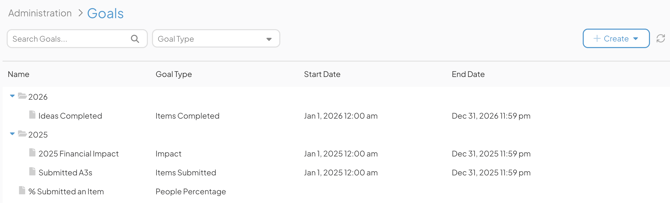
- Each Goal in your organization will be listed. By default, columns displaying each Goal's Type, Start Date, and End Date will be visible.
- Goal folders are also listed, and you can select the blue arrow to the left of a folder to expand or collapse its Goals.
- Use the Goal Type Quick Filter to filter the list for Goals of a certain Type: Impact, Items Submitted, Items Completed, People Count, or People Percentage.
- Use the search bar to quickly find a specific Goal by name.
- Edit columns on the list by hovering over one of the existing column headers, and selecting the dropdown arrow.
- Select Columns to change which columns appear in the list. These changes will be temporary.
Edit a Goal
To edit a Goal, go to Admin and open the Goals page.
- Hover over the Goal you would like to edit. It will highlight blue.
- Select the pencil icon to the right of the Goal.
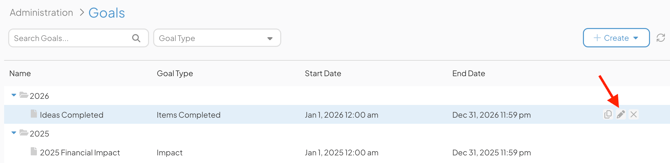
- Use the two tabs in the Edit Goal window: Criteria and Assign Values.
/Goals/Edit%20Goal%20-%20Tabs.jpeg?width=400&height=332&name=Edit%20Goal%20-%20Tabs.jpeg)
Edit a Goal's Criteria
In the Criteria tab, you can edit the parameters an Item or Impact must meet to be counted toward the Goal.
- Name: Edit the name of the Goal.
- Goal Type: Goal Type cannot be edited. Whether a Goal is Items Submitted, Items Completed, or Impact must be dictated when creating a new Goal.
- If the Goal Type is Items Submitted or Items Completed, you can edit:
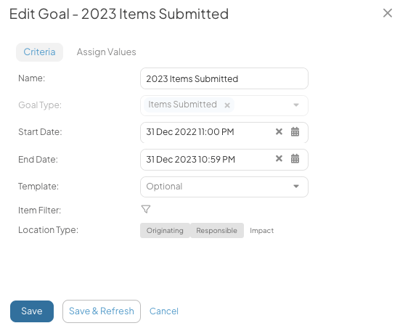
- Start Date: Enter the date you want Goal tracking to begin.
- Item Submitted Goals will only count Items that have been Submitted after this date.
- Item Completed Goals will only count Items that have been Completed after this date.
- End Date: Enter the date you want Goal tracking to end.
- Item Submitted Goals will only count Items that have been Submitted before this date.
- Item Completed Goals will only count Items that have been Completed before this date.
- Start Date: Enter the date you want Goal tracking to begin.
-
- Template: If desired, select one or more Templates . Only Items created from Templates listed in this field will be counted toward the Goal. If no Template is specified, Items of any Template can be counted toward the Goal.
- Item Filter: Select the filter icon to enter the Item Filter. Use the Item Filter when you want to provide more specific criteria as to which Items should be counted toward the Goal.
- Location Type: Use the toggles to select one or more Location Types. This selection will determine which Location on an Item receives credit toward its Goal.
- For example, if you select Responsible as the Location Type, then only an Item's Responsible Location will receive credit when the Item meets the Goal criteria. The Originating and Impact Locations on the Item will not have the Item counted toward their Goals.
- If the Goal Type is Impact, then you can edit:
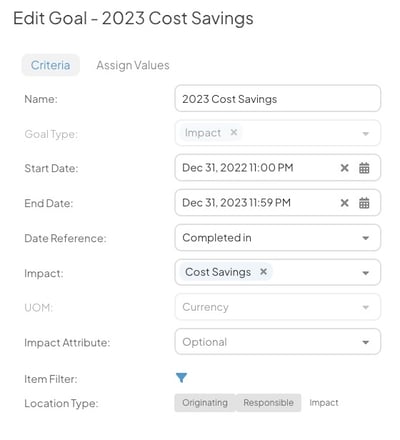
- Start Date: Enter the date you want Goal tracking to begin. Only Impacts on Items with a Date Reference after this date will be counted toward the Goal.
- End Date: Enter the date you want Goal tracking to end. Only Impacts on Items with a Date Reference before this date will be counted toward the Goal.
- Date Reference: Select your Date Reference. The Date Reference determines which Item date the system references when determining whether Impacts fall into your Goal's Date Range.
-
-
- For example, if you select "Completed in", an Item's Impact will only be counted toward the Goal if that Item has a Complete Date between the Goal's Start Date and End Date. If the Item has not been Completed in the date range, the Impact won't be counted.
-
-
- Impact: Select which Impact Types should be counted toward the Goal. You can select multiple Impacts in this field, if desired.
- If you select a Quantitative Impact that supports Impact Values, then an additional Impact Value field will appear. Use this field to narrow down which variations within the Impact should be counted toward the Goal.
- Impact: Select which Impact Types should be counted toward the Goal. You can select multiple Impacts in this field, if desired.
-
- UOM: Select whether the Goal will be tracked in Currency or Units. This will determine which unit of measurement you will use when assigning Goal Values. When the Goal is displayed on a Report or Widget, the Goal will appear in the unit of measurement you select.
- This is important when your Goal tracks Impacts that can be reported in currency or units such as Waste, Product, Resources, Environmental Impact, Time Savings, Takt Time, Cycle Time, and Lead Time.
- If the selected Impact is only reported in currency, then this field will automatically default to Currency and cannot be edited.
- Impact Attribute: Expand this drop-down to select one of your organization's Impact Attributes. When you select an Impact Attribute, an additional drop-down will appear.
- Attribute Value: Select which Attribute Values an Impact must be tagged with to be counted toward your Goal.
- If you enter multiple values, Impacts only need to have one of the listed values to be counted toward the Goal.
- If you leave this field blank, Impacts tagged with any of the Impact Attribute's values will be counted toward the Goal.
- Attribute Value: Select which Attribute Values an Impact must be tagged with to be counted toward your Goal.
- Item Filter: Select the filter icon to enter the Item Filter. Use the Item Filter when you want to provide more specific criteria as to which Item's Impacts can be counted toward the Goal.
- Location Type: Use the toggles to select one or more Location Types that should receive credit for Impacts matching your Goal criteria.
- For example, if you select Responsible as the Location Type, then only an Item's Responsible Location will receive credit when its Impact meets Goal criteria. The Originating and Impact Locations on the Item will not have the Impact counted toward their Goals.
- UOM: Select whether the Goal will be tracked in Currency or Units. This will determine which unit of measurement you will use when assigning Goal Values. When the Goal is displayed on a Report or Widget, the Goal will appear in the unit of measurement you select.
- If the Goal Type is People Count, you can edit:
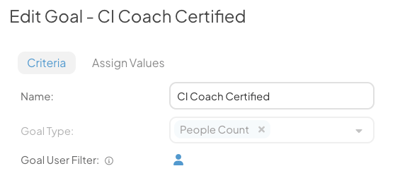
- Goal User Filter: Select the person icon to open the User Filter and set the criteria a user must meet to count toward the Goal.
- If the Goal Type is People Percentage, you can edit:
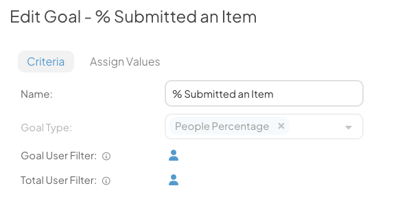
- Goal User Filter: Select the person icon to open the User Filter and set the criteria a user must meet to count toward the Goal. The number of users meeting this criteria will be the numerator in the Goal calculation.
- Total User Filter: Select the person icon to open the User Filter and set the criteria users must meet to be included in the Goal total. The number of users meeting this criteria will be the denominator in the Goal calculation.
- Customizing which users are included in the denominator of the calculation allows you to create more precise Goals. For example, your objective might be to have all leaders in your organization earn a certain Badge. In this example, you'd want to apply the Leader Persona criterion in the Total User Filter so that only leaders are considered while calculating the percentage.
- If you don't enter any criteria for the Goal's total, all user accounts, including Inactive Users, will be used in the calculation. For this reason, we recommend you at least specify a User Type in the total.
/Ofie/Ofie%20Profile%20Pic.png?width=50&height=50&name=Ofie%20Profile%20Pic.png) Pro Tip: People Percentage Goal values are calculated as follows:
Pro Tip: People Percentage Goal values are calculated as follows:
People Percentage Goal value = (Goal User Filter count / Total User Filter count) x 100
- Select Save or Save & Refresh when you are finished editing.
- Save will save your work and return you to the Goals Administration page.
- Save & Refresh will save your work and keep you in the Edit Goal window. Use this option when you also want to assign Goal Values for Locations.
Assign Goal Values for Locations
The Assign Values tab of the Edit Goal window gives you a hub where you can view and edit the Goal Values assigned for every Location in your organization.
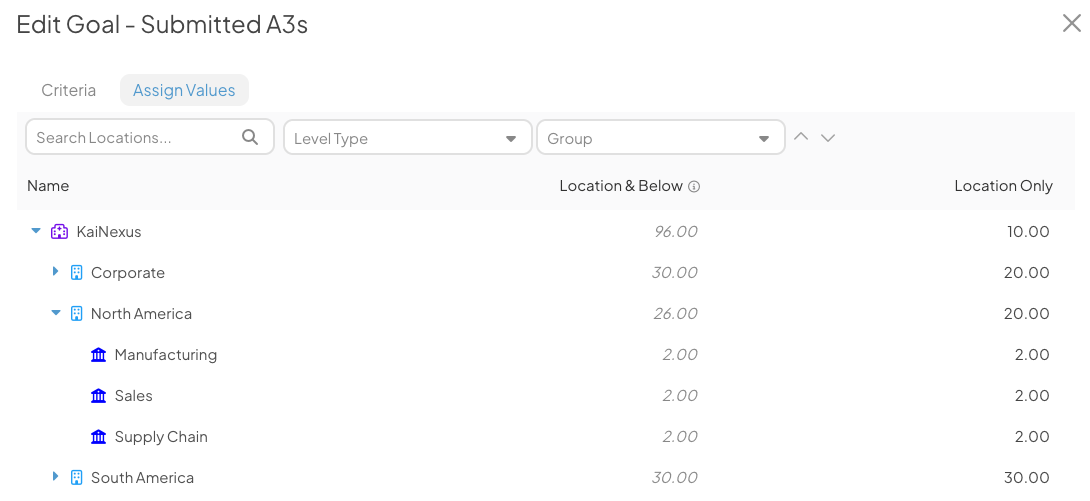
The Location hierarchy appears on the left side of the page. Use the arrows to expand nested Locations, Location Search to find a specific Location, or the Level Type Quick Filter to display only Locations with a selected Level Type.
There are two types of Goal Values you can assign:
- Location & Below: A Goal for a Location and all Locations nested beneath it. Contributions from child Locations count toward this Goal. If left blank, KaiNexus automatically calculates this value based on the Location Only Goals in that branch of the hierarchy.
For example, if Team A and Team B each have a Location Only Goal Value of 10 and are nested beneath IT, KaiNexus automatically calculates a Location & Below Goal Value of 20 for IT. If IT also has its own Location Only Goal Value of 5, the calculated Location & Below Goal Value becomes 25. - Location Only: A Goal for a single Location. Only contributions from that Location count toward the Goal.
Pro Tip: Check out this article for more information on how Location & Below and Location Only Goal Values affect your experience viewing Goal progress on Widgets and Reports.
To assign a Goal Value:
- Hover over a Location and select the existing value or empty space in either the Location & Below or Location Only column.
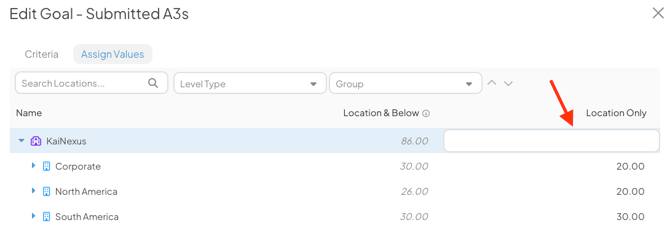
- Enter the desired value.
- Select Save to save your work and return to the Goals admin page.
- Select Save & Refresh to save your work and remain in the Edit Goal window. We recommend saving your work often as you assign Goal Values.
A few things to keep in mind:
- Entering a Location Only Goal Value automatically recalculates any empty or previously calculated Location & Below values.
- Locations waiting to be recalculated display Calculated in the Location & Below column. Select Save & Refresh to view the updated values.
- Locations with a manually assigned Location & Below value will retain that value and will not be affected by changes to Location Only Goal Values.
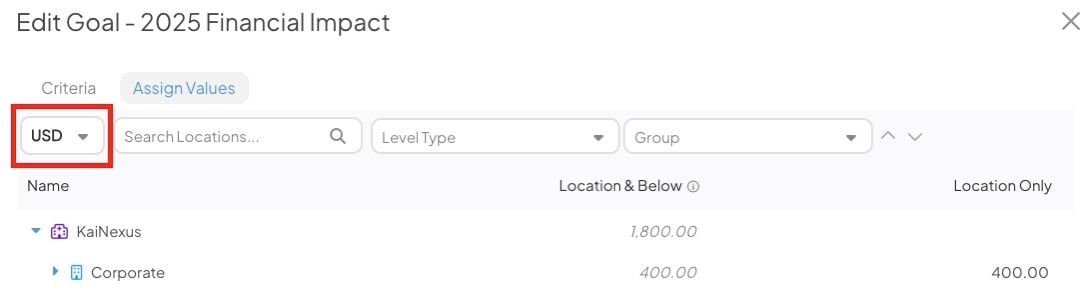
Note: If your organization uses Multi-Currency and you're assigning values for an Impact Goal, there will be a currency dropdown. Use it to select a currency and assign a separate Goal Value for each currency. Goals do not support currency conversion, so Goal progress can only be tracked in one currency at a time.
Edit a Goal folder
If your organization has a large number of Goals, you can organize them into folders to make them easier to review and manage. Folders appear on the Goals administration page and in Goal dropdown menus throughout the platform.
To edit a Goal folder:
- Go to Admin and open the Goals page.
- Hover over the folder, and select the pencil icon on the right.
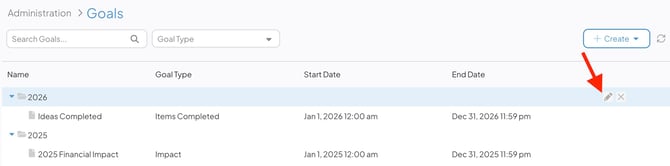
- Update the folder's name in the Edit Goal Folder window.
- Select Save.
Add Goals to a folder
You can add Goals to a folder using drag and drop:
- Hover over the Goal you want to move.
- Click and hold, then drag the Goal to the folder. The folder's row will highlight when you can drop the Goal.
- Release the Goal to add it to the folder.
You can also drag and drop Goals within a folder to reorder them.
What's Next
Now that you have edited Goals and assigned Goal Values, we recommend you check out the article below for a holistic explanation of how Goals work and your options for visualizing a Location's progress toward their Goal.