
 Required: The Advanced ROI Module must be enabled for your organization to perform the functions on this support page. Reach out to your Customer Success Manager to enable it.
The Advanced ROI Module lets you record not just the date an Item was completed, but the specific date (or dates) when each quantitative Impact begins to take effect.
Without Realized Dates, all Impacts on an Item are attributed to Item-level dates, such as the Completed Date. By using Realized Dates, you can track when each Impact actually occurs, enabling more accurate and detailed financial reporting.
This support page will cover:
- Logging an Impact's Realized Date
- Filtering by Realized Date
- The difference between filtering by Completed Date and Realized Date
- What happens to existing One-Time and Recurring Impacts when Realized Dates are turned on
Log an Impact's Realized Date
How you log a Realized Date depends on whether the Impact is One-Time, Recurring, Range, or Custom Schedule.
/Ofie/Ofie%20Profile%20Pic.png?width=50&height=50&name=Ofie%20Profile%20Pic.png) Learn more: For more information on completing an Item and adding Impact, check out this support article.
Learn more: For more information on completing an Item and adding Impact, check out this support article.
One-Time and Recurring Impacts
Important: Realized Dates for One-Time and Recurring Impacts must be enabled at the Template level. If this setting is not enabled, the Realized Date field will not appear.
When adding a One-Time or Recurring quantitative Impact to an Item, the Realized Date field appears below the Amount field (if enabled).
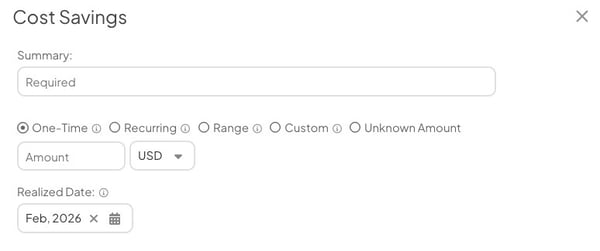
To log the Realized Date:
- Click the calendar icon in the Realized Date field.
- Select the month and year the Impact will take effect. For recurring Impacts, this is month the Impact begins.
- Save the Impact and complete the Item as usual.
Pro Tip: For Recurring Impacts, the annualized amount is distributed evenly across 12 months starting from the Realized Date. For example, a $1,200 yearly recurring Impact with a Realized Date of June 2026 results in $100 per month from June 2026 through May 2027.
Range and Custom Schedule Impacts
Range and Custom Schedule Impacts always include Realized Dates.
Range Impacts include both a Start Date and End Date, each selected by month and year.
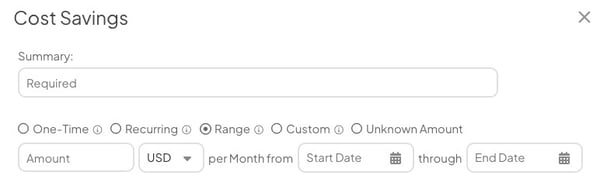
- Click the calendar icon in the Start Date and End Date field.
- Select the appropriate month and year. The Start Date is the first month the Impact is realized, and the End Date is the final month it is realized.
Custom Schedule Impacts allow you to define unique monthly amounts.
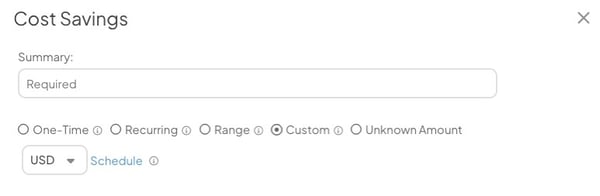
- Click the Schedule link to open the Custom Schedule page.
- Click Add Year to add a year to the schedule.
- Enter values in the appropriate month fields. Each month with a value entered is treated as a realized month for that Impact.
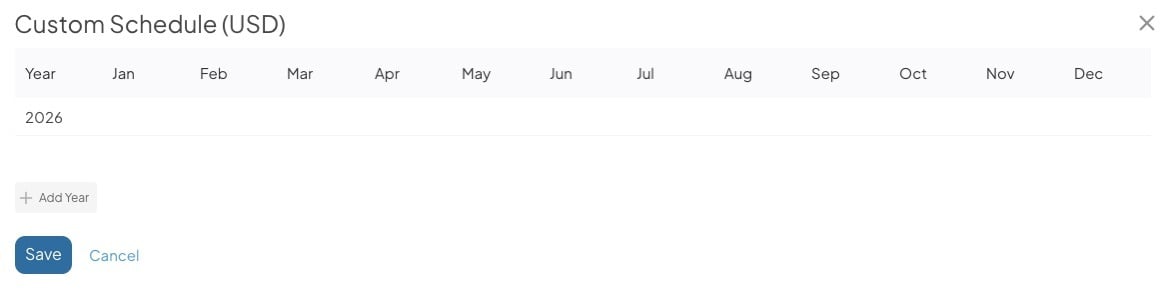
- Click Save when finished.
Filter Data by Realized Date
Realized Dates allow you to build more precise financial Reports by filtering Impacts based on when they were realized.
You can apply a Realized Date filter to the following Reports, both in the Reports section and on a Report Card on a Board. For step by step instructions on how to configure these Reports, check out the following support pages:
- Impact Summary
- Impact Over Time
- Impact by Person
- Impact by Location
- Impact by Item
- Impact by Attribute
You can also filter by Realized Dates in the following areas:
- Impact Widgets
- Item List columns, including Custom Impact Columns and standard Impact columns, which you configure in the Additional Column Options of the Item Filter
Pro Tip: When filtering by Realized Date, avoid using time intervals shorter than one month. Realized Dates are recorded by month, not by individual days, so filtering by specific days or weeks is not meaningful.
If you select a range shorter than a month, the filter will automatically expand the start and end dates to cover the full months of the selected range.
For example, if you set a filter from February 23–March 2, 2026, the Report will include all Impacts with a Realized Date of February or March 2026.
What's the difference between filtering by Complete Date and Realized Date?
Filtering by Complete Date groups all of an Item’s Impact under the date the Item was completed, while filtering by Realized Date displays Impact based on when it actually takes effect, showing a more accurate timeline of when the financial results occur.
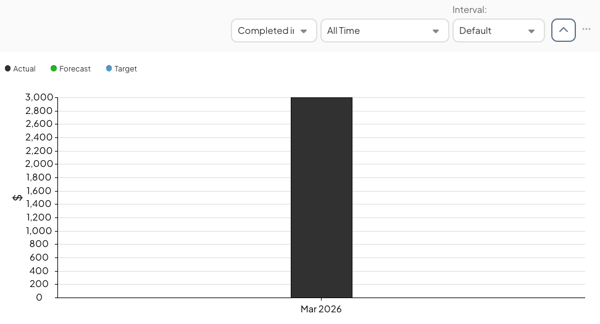
For example, imagine an Item with a Range Impact of $1,000 realized per month from January 2026 through March 2026.
-
If you filter an Impact Over Time Report by Complete Date, the full $3,000 Impact is attributed to March 2026, the month the Item was completed.
-
If you filter by Realized Date, the Impact is distributed across January, February, and March 2026.
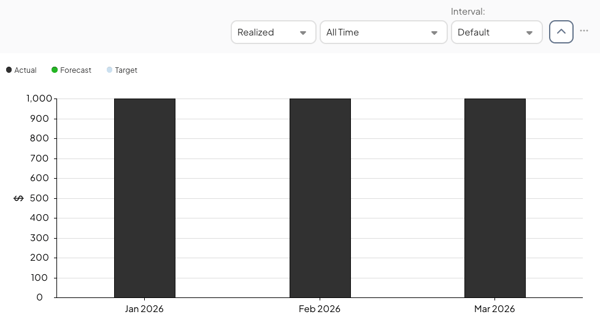
Using Realized Date provides a clearer view of when savings or financial benefits actually occurred, rather than when the work was officially completed.
Caution: When filtering Reports, Widgets, or List columns by Realized Date, Impacts must have a Realized Date to be included. If you have One-Time or Recurring Impacts where Realized Date is not enabled, they won't be included in data filtered by Realized Date.
What happens to existing One-Time and Recurring Impacts when Realized Dates are turned on?
When Realized Dates are enabled on a Template for One-Time or Recurring Impacts, any new quantitative Impacts will require users to enter a Realized Date.
For Items that already have Impacts logged before Realized Dates were enabled, those existing Impacts will automatically be assigned a Realized Date. The system sets the Realized Date to the month when the Item’s Resolution was first created. In many cases, this matches the Completed Date. However, it may be different if Impacts were entered before the Item was officially completed.